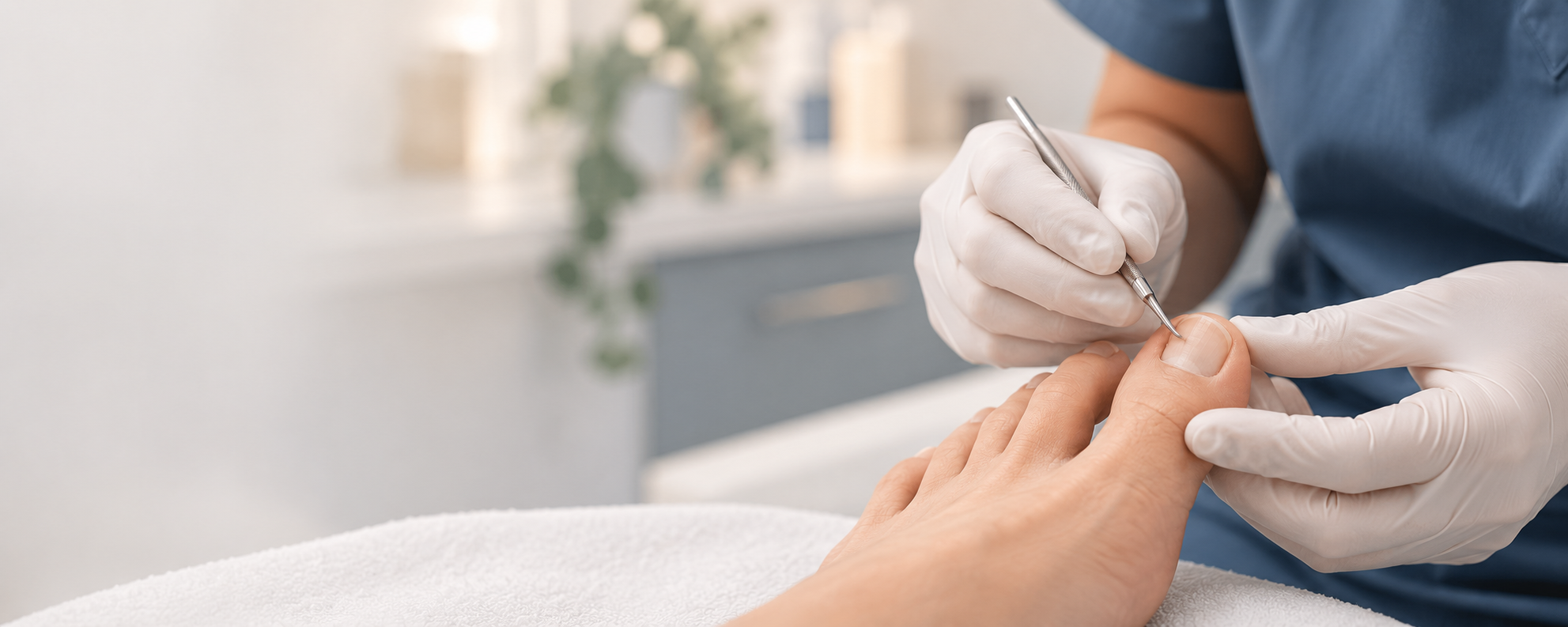
Nail Surgery
The Long term solution for painful or troublesome toe nails.

Assessment
We assess your nail, medical history and circulation to ensure nail surgery is suitable for you.
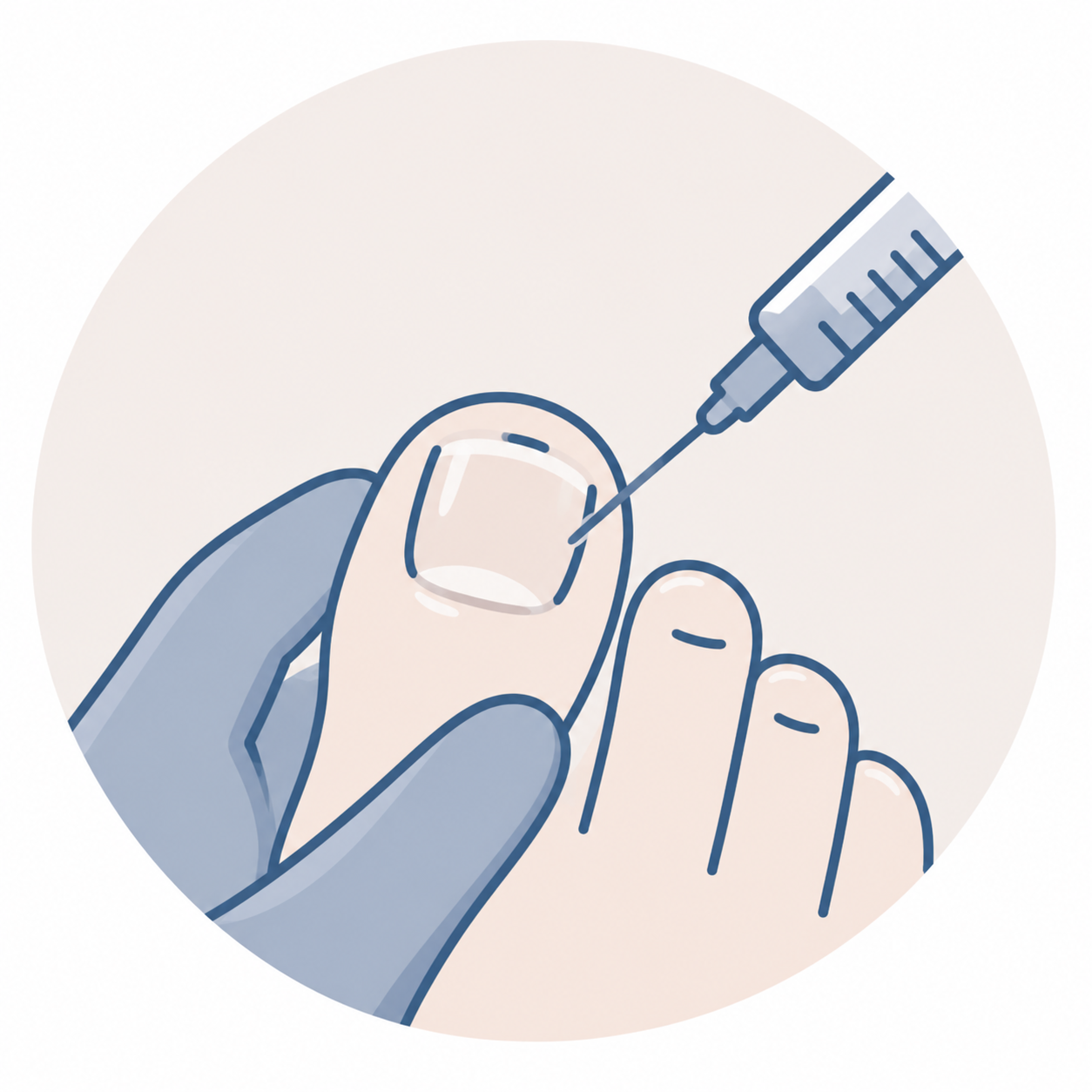
Procedure
The toe is numbed with local anaesthetic before the problematic nail is carefully removed and phenol applied where appropriate.

Aftercare
Your toe is dressed and all the dressings you need for home are provided, along with clear aftercare instructions.

Healing
We’ll guide you through the healing process. Phenolised nail surgery usually heals gradually over several weeks.
A long-term solution for painful or troublesome toenails
Painful, ingrown or repeatedly infected toenails can make walking, wearing shoes and everyday activities uncomfortable. When conservative treatments are no longer helping, nail surgery may provide a more permanent solution.
At Affinity Podiatry, nail surgery is carried out following a full assessment to determine whether the procedure is appropriate for you.
Nail Surgery
-
Nail surgery is a minor procedure performed under local anaesthetic, meaning your toe is completely numb while the procedure is carried out.
Depending on the problem, we may recommend removing:
Part of the nail – known as a Partial Nail Avulsion (PNA). This is commonly used for ingrown toenails, where only the troublesome section of nail is removed.
The whole nail – known as a Total Nail Avulsion (TNA). This may be recommended when the entire nail is problematic.
Where appropriate, a chemical called phenol may be applied to the nail-producing tissue (nail matrix) after the affected section has been removed. This is used to reduce the likelihood of that part of the nail growing back.
Your clinician will discuss the most suitable option with you before treatment.
-
Nail surgery is a commonly performed minor procedure, but—as with any procedure—there are potential risks.
These can include pain, bleeding, infection, delayed healing, changes to the appearance of the nail, reaction to local anaesthetic and regrowth of the treated nail.
Your individual risks and suitability for treatment will be discussed during your assessment.
-
Nail surgery may be considered for:
Recurrent or persistent ingrown toenails
Painful toenails that repeatedly dig into the surrounding skin
Recurring inflammation or infection around the nail
Nails that have not responded to conservative treatment
Damaged or significantly distorted nails causing ongoing problems
Not every painful or ingrown toenail requires surgery. In some cases, more conservative treatment may be suitable.
-
Before nail surgery, we carry out an assessment of your toe and general health.
This may include reviewing your medical history and medication, examining the nail and surrounding skin, and assessing the circulation and sensation in your feet where appropriate.
We will explain the procedure, expected healing process, potential risks and alternative treatment options. You will also have the opportunity to ask any questions before deciding whether you would like to proceed.
-
Local anaesthetic is carefully administered at the base of the toe. Once the toe is completely numb, the affected part or whole of the nail is removed.
If phenolisation is appropriate, phenol is then applied to the nail matrix to help prevent the unwanted section of nail from regrowing.
A sterile dressing is applied before you leave the clinic.
Although you should not feel pain during the procedure once the anaesthetic has taken effect, you may still be aware of pressure or movement.
-
The local anaesthetic will gradually wear off following the procedure, and some discomfort can be expected afterwards.
You will be given clear aftercare instructions explaining how to look after your toe and change the dressing while it heals.
We will provide you with the dressings you need for your aftercare, so you have the appropriate supplies to continue dressing the toe at home. We will also show you how to change the dressing and explain how often this should be done.
Healing is gradual and the toe may continue to produce some discharge while the area heals, particularly when phenol has been used. This can be a normal part of the healing process.
Your clinician will advise you about dressings, footwear, bathing and returning to your usual activities.
-
If phenol is used, the aim is to permanently prevent the treated section of nail from growing back. Phenolisation is around 97% effective at preventing nail regrowth, making recurrence uncommon.
With a partial nail removal, only the problematic section of nail is treated, allowing the remaining nail to continue growing normally and leaving a slightly narrower nail.
Although phenolisation has a very high success rate, no procedure can guarantee that regrowth will never occur.
-
Healing times vary from person to person and depend on the procedure performed, your general health and how well the area heals.
Phenolised nail surgery commonly takes several weeks to fully heal, and occasionally longer. We will monitor your progress and advise you if anything requires additional attention.