Why Does My Heel Hurt When I Get Out of Bed?
Morning heel pain, plantar fasciitis and when to see a podiatrist.

You get out of bed, put your foot on the floor and ouch.
That sharp pain under your heel during those first few steps in the morning is a very common reason people seek help for heel pain. It may ease after you've walked around for a little while, only to return after sitting down for a long period or after a busy day on your feet.
One of the most common causes of this type of heel pain is plantar fasciitis, but it isn't the only possibility.
What is plantar fasciitis?
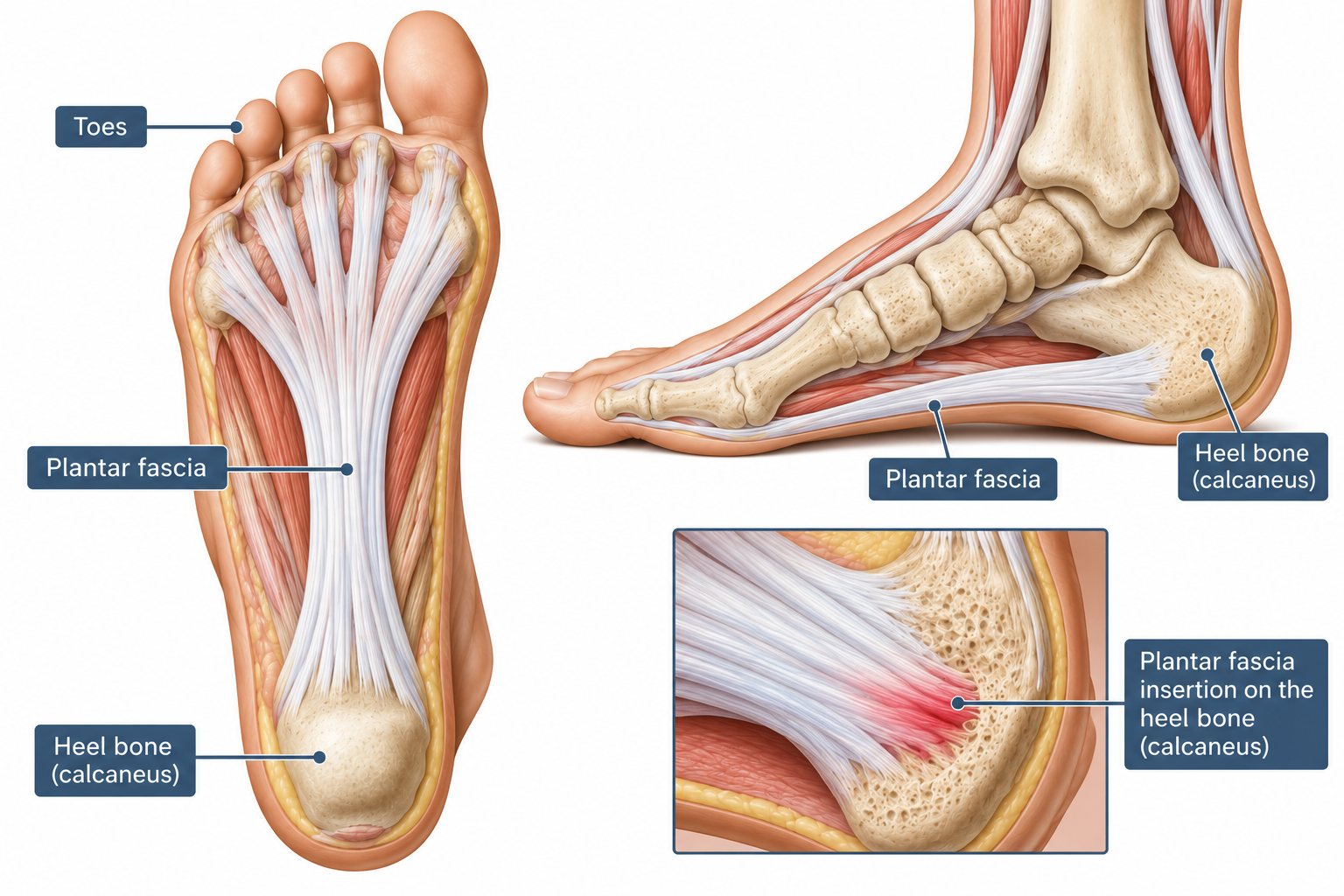
The plantar fascia is a strong band of connective tissue that runs along the bottom of your foot, connecting your heel to the front of your foot. It helps support the arch and plays an important role when you walk.
When the plantar fascia becomes irritated or overloaded, pain can develop where it attaches around the heel.
Typical symptoms can include:
Pain underneath or around the heel
Pain with the first few steps after getting out of bed
Pain when standing after sitting for a while
Symptoms that initially improve as you start moving
Pain that becomes worse after prolonged standing, walking or exercise
Why does it hurt so much in the morning?
While you're sleeping, your foot isn't moving or taking weight for several hours.
When you stand up and take those first few steps, the plantar fascia is suddenly placed under load again. If the area is already irritated, this can produce the familiar sharp or pulling pain beneath the heel.
After you've walked for a little while, the tissues warm up and the discomfort may reduce. This can make it tempting to ignore the problem.
However, if the pain repeatedly returns, it's worth looking at why the heel is being overloaded in the first place.
What causes plantar heel pain?
There isn't always one single cause.
Heel pain can develop due to a combination of factors, including changes in activity levels, prolonged standing, footwear, foot mechanics, reduced ankle movement and increased load through the foot.
Sometimes something as simple as suddenly walking much further than usual, starting a new exercise programme or changing footwear can be enough to trigger symptoms.
This is why treating heel pain isn't always as simple as buying a pair of insoles or doing one particular stretch.
Is all heel pain plantar fasciitis?
No.
Although plantar fasciitis is a common cause of pain underneath the heel, there are several other conditions that can cause pain in this area.
These can include problems involving the Achilles tendon, the heel's natural cushioning tissues, nerves, joints and other structures around the foot and ankle.
Where the pain is located, when it occurs and what makes it better or worse can all provide useful clues.
This is one reason we don't recommend assuming that every painful heel is plantar fasciitis.
What can I do about heel pain?
If your heel pain has only recently started, reducing activities that aggravate it may help. Supportive, comfortable footwear can also make a difference, particularly if you've been spending a lot of time barefoot or wearing very flat or unsupportive shoes.
Depending on the cause, treatment may include exercises, stretching, footwear advice, changes to activity and, in some cases, insoles or orthoses.
There isn't one treatment that is right for everybody.
When should I see a podiatrist?
Consider having your heel pain assessed if it:
Isn't improving
Keeps returning
Is affecting your normal walking or activities
Has become progressively worse
Is present in more than one area of the foot
Has started without an obvious reason
You should seek medical advice more urgently if heel pain follows a significant injury, you cannot put weight through the foot, or it is accompanied by significant swelling, redness, heat, numbness or other concerning symptoms.
How can we help?
At Affinity Podiatry, we don't just look at where it hurts.
A biomechanical assessment can help us look at how your feet and lower limbs are functioning, your movement, footwear and other factors that may be contributing to your symptoms.
Depending on what we find, your treatment plan may include tailored exercises, footwear advice, activity modifications and orthoses where appropriate.
The aim is to understand what's contributing to your heel pain and create a treatment plan suited to you, rather than simply treating every painful heel in the same way.
Heel pain doesn't have to become something you simply put up with.
If you're experiencing persistent heel pain, contact Affinity Podiatry to arrange an assessment.
-
NHS – Heel pain
Koc TA Jr et al. (2023) – Heel Pain–Plantar Fasciitis: Revision 2023
Morrissey D et al. (2021) – Management of plantar heel pain: a best practice guide
Trojian T & Tucker AK (2019) – Plantar Fasciitis
Riddle DL et al. (2003) – Risk factors for plantar fasciitis
DiGiovanni BF et al. (2003) – Plantar fascia-specific stretching exercise
DiGiovanni BF et al. (2006) – Plantar fascia-specific stretching: two-year follow-up
Whittaker GA et al. (2018) – Foot orthoses for plantar heel pain
Alshami AM et al. (2008) – Plantar heel pain of neural origin